What every order costs you, forever
Some platforms take a percentage of each sale on top of the subscription. That fee scales exactly with your success and never stops. It is the only software cost you have that grows when you have a good month.

Most businesses choose an ecommerce platform on price and design, then spend the next three years paying for that decision in transaction fees, app subscriptions and a migration nobody budgeted for. This guide gives you a scorecard, a five-year cost model, and the seven questions that expose a platform's limits on a demo call.
Most ecommerce platform decisions are made in about a week, on the basis of a pricing page and a theme gallery. Most of them are regretted somewhere in year two — not because the platform was bad, but because the business changed and the platform couldn't.
The symptoms are always the same. A transaction fee that was trivial at 40 orders a month is a serious line item at 4,000. Six paid apps are doing the job you assumed the platform did. Your dealers want wholesale pricing and the only answer is a second store. Someone quotes a six-figure number to replatform, and you discover the real cost of the decision you made in that week.
This guide is the framework we'd use. It covers how to diagnose what you actually need, a twelve-point scorecard you can run against any shortlist, the five-year cost model that changes most decisions, where each type of platform breaks down, and the seven questions that get an honest answer out of a sales demo.
It's written by the team behind Shopaccino, an ecommerce platform used by 1,000+ brands across 25+ countries. We'll tell you where we're the right answer, and we'll tell you plainly where we're not — including a section on exactly that, because a guide that recommends itself at every turn isn't a guide.
In this guide
A website gets replaced when it looks dated. An ecommerce platform gets replaced when it stops being possible to run the business on it — and that's a much more expensive event.
The platform you pick quietly decides five things, and four of them never appear on the pricing page.
Some platforms take a percentage of each sale on top of the subscription. That fee scales exactly with your success and never stops. It is the only software cost you have that grows when you have a good month.
A low headline price usually means abandoned-cart recovery, multi-currency, product options, loyalty and B2B pricing are paid apps. Six apps at $20/month is $1,440 a year that wasn't in the comparison you made.
Hosting, CDN, image optimisation and theme weight decide whether a buyer on a mid-range Android and a patchy connection ever reaches your product page. Platform-level speed is not something you can fix later with a plugin.
The day you want a mobile app, a dealer portal, a second currency, or stock split across three warehouses — either your platform does it or you start the migration conversation.
Your own domain and your own exportable customer database, or someone else's. This is the one that decides whether you are building an asset or renting an audience.
Describe your business as it will be in three years — order volume, channels, countries, customer types. If the platform you're about to choose can't do that version of your business without a migration, you're not choosing a platform. You're choosing a stopgap and a future project.
We see businesses migrate onto Shopaccino every month, and the reason is almost never “the old platform was bad”. It's one of these five.
The platform that's comfortable at 30 orders a day often becomes the bottleneck at 300 — manual waybills, no bulk order actions, inventory that doesn't sync across channels. Buy for the volume you're planning for, not the one you have.
Every app is a vendor, a subscription, an update cycle and a point of failure. When an app breaks on a Saturday, support points at the other vendor. A platform where the core commerce features are native has fewer moving parts and one phone number.
The headline price is the smallest number in the decision. Transaction fees, apps, theme development, developer retainers and gateway rates are the rest of it — and they're where the difference between two platforms usually turns out to be three to five times.
Retail-only platforms struggle the day a distributor asks for wholesale rates and a credit limit. Running a second store for B2B means two catalogues, two stock pools and two sets of errors.
Selling where the checkout, the customer data and the brand belong to someone else is fast and feels productive. It also means you're renting your customer relationships. Use those channels — just don't build the business's foundation on them.
Nearly every bad platform choice starts with evaluating platforms before deciding what the business needs. Answer these seven questions first, in writing. They take two minutes and they eliminate half your shortlist before you've sat through a single demo.
Now count. Three or more answers in the “and also” column — B2B and B2C, multiple warehouses, several channels, more than one country — and you need a platform that does all of it natively. Every one of those needs met by a workaround becomes a daily operational tax.
Write the answers down and keep them next to you for the rest of the evaluation. When a salesperson says “yes, we can do that”, the follow-up question is which of these it does natively, which needs an app, and which needs a developer. Those three answers are very different prices.
This is the core of the evaluation. Score each shortlisted platform 0–2 on every line: 0 = can't do it, 1 = possible with a paid app or custom work, 2 = native and included. Twenty-four is a perfect score; anything below 16 for your business type will cost you later.
| # | Check | What a score of 2 looks like | Why it decides the outcome |
|---|---|---|---|
| 1 | Platform transaction fees | 0% on every plan, on every order | A 2% cut compounds with your growth and never stops. It's the only cost that punishes a good quarter |
| 2 | What's included vs. sold as apps | Abandoned cart, SEO tools, inventory, tax, notifications, backups — native | Six “small” apps is routinely more than the subscription itself |
| 3 | Payment methods your buyers use | UPI, cards, net banking, wallets, EMI, BNPL, COD — your choice of gateway | The last click is where the sale is lost. A missing payment method is a conversion ceiling you can't see |
| 4 | Shipping & courier integration | Multiple couriers, automatic waybill generation, live tracking, serviceability checks | Manual label creation works at 5 orders a day and collapses at 50 |
| 5 | Inventory across channels & locations | One stock pool across web, app, marketplaces and warehouses, syncing live | Overselling costs a refund, a review and a customer. It's the most common ops failure in growing stores |
| 6 | B2B capability on the same store | Group pricing, MOQ, credit terms, gated catalogue — same catalogue as retail | If you ever sell wholesale, retrofitting this means a second store or a migration |
| 7 | Multi-currency & multi-region | Region-based catalogues, pricing and tax, not just a currency converter | Export selling is often the cheapest growth available — if the platform doesn't block it |
| 8 | Native mobile app | Your brand, iOS + Android, with segmented push notifications | Repeat buyers convert markedly better in an app, and push is the cheapest retention channel you'll own |
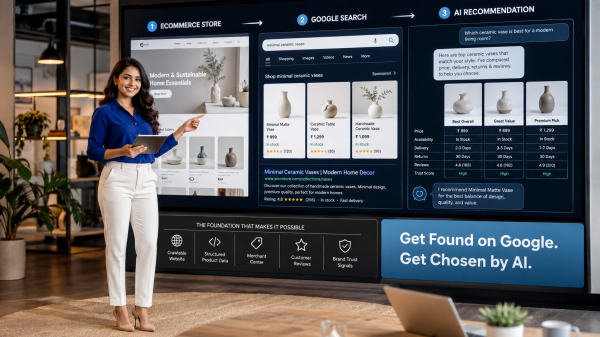
| 9 | SEO & structured data | Clean URLs, full meta control, schema, sitemaps, fast mobile rendering — built in | This is also what decides whether AI assistants can read and recommend your catalogue |
| 10 | Tax & compliant invoicing | GST-compliant invoicing with HSN codes, correct intra/inter-state treatment, automatic | Getting this wrong is an accounting problem, not a website problem |
| 11 | Integrations with what you already run | Native connectors for your accounting or ERP — Tally, Zoho, Dynamics 365, Unicommerce | “We have an API” means a developer project. A connector means a settings page |
| 12 | Support in your timezone | Named human, same working hours, reachable by phone | The day checkout breaks, response time is the only feature that matters |
Swipe the table horizontally on mobile.
Two notes on using this honestly.
Weight it to your diagnosis. If you'll never sell B2B or export, lines 6 and 7 don't apply — drop them and score out of 20. Don't let a platform win on features you'll never use.
Score what's in your plan, not what's on the brochure. Most of these features exist somewhere in every major platform's product line. The question is whether they're in the plan you can afford, on the plan you'd actually buy.
This is the section that changes most decisions, and almost nobody does the arithmetic before signing.
| Cost | How it behaves | Typically overlooked? |
|---|---|---|
| Subscription | Fixed, predictable, visible | No — it's the only one people compare |
| Platform transaction fee | Percentage of every order. Grows with revenue. Never ends | Yes — and it's usually the biggest |
| Apps & add-ons | Fixed per app, but the count only ever rises | Yes |
| Development & maintenance | Theme work, custom features, integration fixes, a retainer | Yes |
A 2% platform fee on a $14 order is 28 cents. It doesn't feel like a decision. Run it forward:
| Annual turnover | 2% platform fee | 1% platform fee | Shopaccino (0%) |
|---|---|---|---|
| $60,000 | $1,200/yr | $600/yr | $0 |
| $250,000 | $5,000/yr | $2,500/yr | $0 |
| $1,000,000 | $20,000/yr | $10,000/yr | $0 |
| Over 5 years at $250k/yr | $25,000 | $12,500 | $0 |
Illustrative model. Figures assume a flat platform fee on gross order value and exclude payment gateway charges, which are separate and unavoidable.
That is money leaving the business whether the month was profitable or not, charged by your software vendor on revenue they didn't generate. At $250k of turnover, a 2% fee is several times the cost of the entire subscription.
Shopaccino charges no platform transaction fee on StartUp, Scale, ProCommerce or TailorMade. You connect your own payment gateway and pay that gateway its processing rate. Nothing on order value comes to us — so your software cost stays flat while your revenue doesn't.
Fill this in for each shortlisted platform. The ranking usually changes.
| Line | Platform A | Platform B | Shopaccino |
|---|---|---|---|
| Subscription × 5 years | from $1,450 (StartUp, 5 yrs) | ||
| Platform transaction fee on projected revenue | $0 | ||
| Paid apps you'd need × 5 years | $0 for core commerce features | ||
| Theme & custom development | |||
| Developer retainer or agency | |||
| Likely migration in year 3–4 | |||
| Five-year total |
If a platform can't support the business you're planning to be in three years, a migration belongs in the comparison — data transfer, rebuilt integrations, re-theming, SEO recovery and the weeks of attention it takes from the people running the business. It's regularly the single largest number on this worksheet. The cheapest platform is frequently the one that makes you move.
Before comparing individual products, narrow to the right category. Each type is genuinely the correct answer for someone — the mistake is picking one that's right for a business unlike yours.
| Platform type | Real strength | Where it breaks down | Right for |
|---|---|---|---|
| Website builder with a shop | Cheapest, fastest, fine design tools | Thin commerce logic — breaks at volume, variants, multi-channel or B2B | A handful of products, a few orders a week |
| Marketplace seller account | Instant traffic, no setup | You own no customer, no data, no brand; you compete only on price | Reach as a channel — never as the foundation |
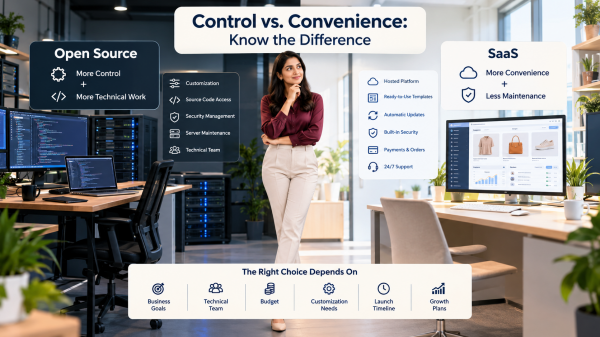
| Open-source, self-hosted | Total control, no licence fee | You own hosting, security, PCI compliance, updates and a developer bill forever | Teams with in-house engineering and a genuinely unusual requirement |
| Hosted SaaS commerce platform | Commerce features native, hosting and security handled, predictable cost | Less freedom than code-level control | Most growing brands — D2C, retail, B2B, or both |
| Headless / composable | Any front-end, any channel | Needs a development team permanently; the front-end is now your problem | Enterprises with engineering capacity and bespoke storefront needs |
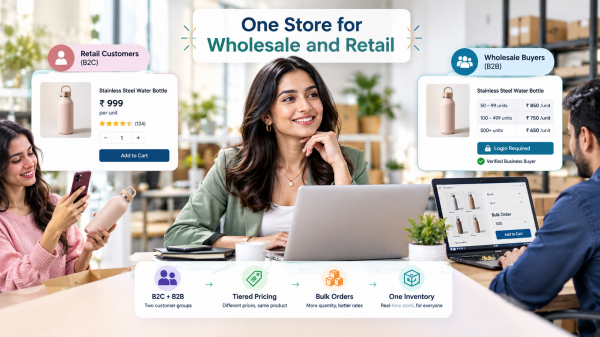
This deserves its own section because it's where the most money gets wasted. A large share of businesses going online are already distributors, wholesalers or manufacturers with a dealer network — and almost every platform is built for retail first and bolts wholesale on afterwards.
Each dealer sees their negotiated rate, not a public one — and never another dealer's.
Minimum order quantities and quantity-based price slabs, set by product and by customer group.
Orders placed on account, with visible limits enforced at checkout rather than checked by hand.
Wholesale pricing your competitors can't see, and ranges released only to approved accounts.
Bulk order forms and one-tap repeat orders — not a retail cart designed for browsing.
Retail and wholesale drawing on the same inventory, with ERP and accounting sync behind it.
“Show me one product, with one stock count, where a retail visitor sees $50, a logged-in dealer sees their negotiated rate with their MOQ and credit balance, and both orders draw from the same inventory.”
If the answer involves a second store, a second catalogue, or a custom build, you've found the limit. Two stores means two stock pools, two sets of product updates, and a reconciliation problem every week.
Shopaccino runs B2B and B2C from one catalogue and one stock pool. Group-specific pricing, MOQ, bulk slabs, credit terms, gated catalogues and multi-warehouse routing are platform features, available from the ProCommerce plan — not a separate product and not a second store. Dealers can order through your branded mobile app, which is usually the thing that actually shifts order volume off WhatsApp and phone calls.
Sales demos show you the happy path. These questions find the edges. Ask all seven of every vendor, including us, and compare the answers rather than the demos.
Listen for the distinction between platform fees and payment gateway fees. Gateway fees are unavoidable and go to the gateway. Platform fees go to the software vendor, and you should know exactly what they are. (Shopaccino: 0% on every plan.)
Ask them to say it line by line. Then add up the apps and recalculate the monthly price.
Not a flagship built by their enterprise team. Someone like you, on the plan you'd buy.
Pick the one on your three-year horizon. The answer is a settings page, an app, a plan upgrade, or a migration — and you want to know which today.
A vendor confident in their product answers this instantly. Hesitation tells you how the relationship ends.
Who picks up, in what timezone, through which channel, and what's the realistic response time? Ask for it in writing.
The honest answer is informative. The evasive answer is more informative.
You've read ten sections of framework. Here's the part where we tell you where we land on it, with the same honesty we've asked you to demand from everyone else.
On every plan — StartUp, Scale, ProCommerce and TailorMade. We take no cut of your orders. You pay your payment gateway its processing rate and nothing to us on order value.
Abandoned-cart recovery, SEO toolkit, inventory and tax management, order notifications by email and SMS, automated backups, cloud hosting with image CDN and SSL — included, on every plan.
48 payment gateways covering UPI, cards, net banking, wallets, EMI and BNPL. 26 courier partners with automatic waybill generation. GST-compliant invoicing with HSN codes. 7 ERP connectors including Tally, Zoho, Dynamics 365 and Unicommerce.
Group pricing, MOQ, bulk slabs, credit terms and gated catalogues on the same catalogue and the same stock pool as your retail storefront.
iOS and Android with segmented push notifications — the cheapest retention channel you will ever own, and not a separate development project.
Multi-warehouse routing, loyalty and reward points, referral programs, multi-store, multi-vendor marketplace, sales territories and localised storefronts. You move up a plan, not onto a new vendor.
4.7/5 on G2 across 34 verified merchant reviews · NASSCOM Excellence Award 2025 for Transformation Catalyst for SMEs · ET Leadership Excellence Award (2023 and 2025) · Crozdesk Leader and Happiest Users.
Shopaccino earns its subscription when you want your own customers, your own margin, and the ability to add a channel, a country or a customer type without starting over.
Most people reading a guide like this aren't starting from zero. They're on something that works, mostly, and wondering whether the disruption is worth it.
You're paying a platform to be a container for other people's software.
Exporting orders into a spreadsheet to create waybills. Updating stock twice because channels don't sync. That's a recurring tax with compounding interest.
Open last year's invoices and add up what you paid your platform on order value. If it's a salary, it's a decision.
The platform is now shaping your business strategy instead of serving it.
Done properly, in this order: audit the data (products, variants, customers, orders, URLs), rebuild the catalogue and theme on the new platform, map every old URL to a new one with 301 redirects, reconnect payments, couriers, accounting and marketing tools, run both in parallel while testing real orders, then cut over — ideally in your quietest fortnight, never in peak season.
The part that gets forgotten is SEO. Product and category URLs carry your rankings. A migration without a complete redirect map is how businesses lose a large share of their organic traffic and spend months getting it back.
Migration support covers catalogue and customer data transfer, theme setup and redirect mapping, with a named person managing the move. Talk to us about migrating →
The right ecommerce platform isn't the one with the best demo or the lowest monthly price. It's the one that still fits when you've added a channel, a warehouse, a currency or a customer type you hadn't planned for — and that hasn't been quietly taking a percentage of every order you made along the way.
Do the three pieces of arithmetic in this guide: score your shortlist out of 24, work out the five-year cost including transaction fees and apps, and ask every vendor the same seven questions. The decision usually makes itself.
Diagnose your business model first — who buys from you, expected order volume, SKU complexity, stock locations, channels, countries and required integrations. Then:
Hosted platforms typically run from a few hundred to a few thousand dollars a year, but the subscription is the smallest part. Add platform transaction fees (0–2% of every order), paid apps for features that aren't native, and development work. Shopaccino plans start at US$290/year with 0% platform transaction fees on every plan, so the cost doesn't grow with your revenue. See pricing.
No, and the distinction matters. A payment gateway fee (around 2%) goes to the company processing the payment and is unavoidable. A platform transaction fee is an additional cut taken by your software vendor on order value — avoidable, and charged on every order forever. Shopaccino charges 0% platform transaction fees.
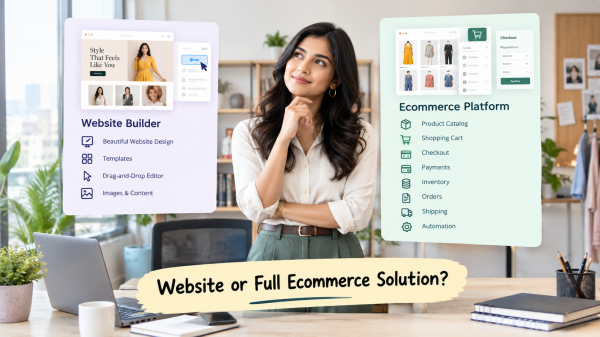
A website builder is fine for a small, simple catalogue and a few orders a week. An ecommerce platform earns its cost the moment you have variants, real order volume, multiple channels, inventory to keep accurate or business customers to price differently. Full comparison.
Yes, if it's built for it. You need group-specific pricing, MOQ, credit terms and gated catalogues running on the same catalogue and stock pool as your retail storefront. Shopaccino does this natively — a retail visitor sees retail pricing while a logged-in dealer sees their negotiated rate, their MOQ and their credit balance, both drawing on the same inventory. How it works.
Increasingly, yes. AI shopping assistants read the same structured data, clean URLs and fast, crawlable product pages that search engines do. A platform with weak SEO fundamentals limits both. Read: ecommerce SEO in the AI era.